


What is the CFA Program?
Once you clear all three levels and complete the required professional work experience, you earn the CFA charter, making you a CFA charterholder — a title respected across investment banks, asset management firms, hedge funds, insurance companies, and corporate finance departments worldwide.
The designation is valued because it signals rigorous, standardized training in investment analysis and a documented commitment to ethical practice. Charterholders commonly move into roles such as equity research analyst, portfolio manager, risk analyst, investment banker, and corporate financial analyst.
Because eligibility rules determine whether you can even sit for Level I, understanding the CFA eligibility criteria 2026 before you commit time and money to preparation is the sensible first step.
CFA Eligibility Criteria 2026
You are eligible if you meet at least one of these:
- You hold a bachelor’s (or equivalent) degree from an accredited college or university, in any discipline.
- You are an undergraduate student within 23 months of your expected graduation month (commonly referred to as the “final-year” allowance).
- You have a combination of professional work experience and/or higher education totaling 4,000 hours, accumulated over a minimum of three consecutive years (education and work experience cannot overlap).
Plus, every candidate must also:
- Hold a valid international travel passport — this is the only accepted form of ID at the test center.
- Be comfortable with the English language, since the exam and curriculum are delivered only in English (no formal test score like IELTS/TOEFL is required).
- Agree to the Professional Conduct Statement (PCS) and the CFA Institute Code of Ethics.
- Reside in a country where CFA Institute is permitted to conduct business (i.e., not subject to sanctions such as those enforced by the US Office of Foreign Assets Control).
What Are CFA Requirements?
1. Academic Requirements
A completed bachelor’s degree, or final-year enrollment, or the 4,000-hour alternate route described above.
2. Identification Requirements
A valid, unexpired international passport is the sole accepted ID at CFA exam centers. Your name on the passport must match your CFA Institute profile exactly.
3. Exam Registration Requirements
You’ll need a CFA Institute account, a chosen exam window, and payment of the enrollment and registration fees.
4. Ethics & Conduct Requirements
Every candidate signs the Professional Conduct Statement, agreeing to the Code of Ethics and Standards of Professional Conduct. This isn’t a one-time formality — you re-affirm it at every level.
5. Computer & Testing Requirements
Since CFA exams are computer-based and delivered at Prometric test centers, candidates should be comfortable with on-screen navigation, the exam software’s calculator functions, and basic digital test-taking tools (practice through the CFA Institute’s mock exam platform is recommended).
✅ Quick Checklist
✅ Valid Passport
✅ Graduation Eligibility (degree or final-year status)
✅ CFA Institute Account created
✅ Payment of enrollment/registration fee completed
CFA Qualification Requirements
Bachelor’s Degree Holders
Any bachelor’s degree — B.Com, BBA, BA, BSc, B.Tech, or equivalent — from a recognized university qualifies. There is no requirement that the degree be in finance, economics, or commerce.
Final-Year Students
If you’re within 23 months of your expected graduation date, you can register for and sit Level I. However, you must complete your degree before you’re allowed to sit for Level II.
Professional Work Experience Route
Candidates without a completed or in-progress degree can still qualify with 4,000 hours of relevant work experience and/or higher education, spread over a minimum of three consecutive years.
The Combination Rule
Work experience and education can be combined to reach the 4,000-hour threshold, as long as the two don’t overlap in time. For example, two years of full-time work plus part-time coursework could combine to meet the requirement.
Who Is Eligible?
How Does the 23-Month Student Rule Work?
Why This Matters
This rule allows ambitious students to start their CFA journey well before finishing their degree — building a head start on both knowledge and career opportunities.
Important Restriction
While you can sit Level I as an undergraduate under this rule, you must complete your bachelor’s degree before you’re allowed to register for or sit Level II. If your graduation is delayed, your Level II eligibility is delayed with it.
Timeline Illustration
Undergraduate Year (within 23 months of graduation)
↓
Register for CFA Level I
↓
Appear for Level I Exam
↓
Complete Bachelor’s Degree
↓
Register & Appear for Level II
CFA Level 1 Eligibility
Who can appear:
- Bachelor’s degree holders (any discipline)
- Final-year students within 23 months of graduation
- Candidates with 4,000 hours of work/education experience over 3+ years
Additional conditions: valid passport, Professional Conduct Statement, and residence in a permitted country.
Fees: A one-time enrollment fee (paid only at first-time Level I registration) plus a per-exam registration fee, which is lower if you register early in the exam window.
CFA Level 2 Eligibility
CFA Level 3 Eligibility
- You must have passed CFA Level II.
- You register through the same CFA Institute portal, choosing an available exam window.
- Preparation should include the Practical Skills Modules (PSMs) — applied, case-based online modules that are a required part of the curriculum starting at this stage.
- The Professional Conduct Statement must be affirmed again at registration.
No new education or passport requirement is introduced at Level III — it’s purely a continuation of your existing candidacy, assuming Level II is cleared.
Exemptions in CFA After CA
Short answer: No formal exemption exists. CFA Institute does not have a policy that waives any CFA level for CA-qualified candidates. However, CAs are automatically eligible to register (their CA qualification and articleship experience typically satisfy either the degree or work-experience route), and many CAs find the CFA curriculum — particularly financial statement analysis, ethics, and corporate finance — significantly easier due to overlapping knowledge.
CFA Eligibility for Different Students
- Commerce Students (B.Com/BBA): Fully eligible; commerce background often eases the learning curve for accounting and corporate finance topics.
- Engineering Students: Eligible with any engineering degree; strong quantitative skills often help with the quant and derivatives sections.
- MBA Graduates: Eligible, especially those with a finance specialization, though it’s not a prerequisite.
- CA (Chartered Accountants): Eligible; overlapping knowledge in financial reporting is an advantage.
- CS (Company Secretaries): Eligible via degree or work experience; corporate law background helps with regulatory topics.
- CMA (Cost & Management Accountants): Eligible; cost accounting knowledge supports corporate finance topics.
- Working Professionals (no degree): Eligible via the 4,000-hour work/education route.
- NRIs: Eligible, provided they meet the standard education/experience criteria and reside in a permitted country.
- International Students: Eligible under the same global rules; degree equivalency is assessed by CFA Institute if the degree is from a non-standard system.
Documents Required for CFA Registration
- ✅ Valid international passport (primary ID; used for both registration and exam-day verification)
- ✅ Passport-size photograph (as per CFA Institute’s profile photo specifications)
- ✅ Payment method (credit/debit card or accepted online payment option for fees)
- ✅ CFA Institute account with accurate personal and academic details
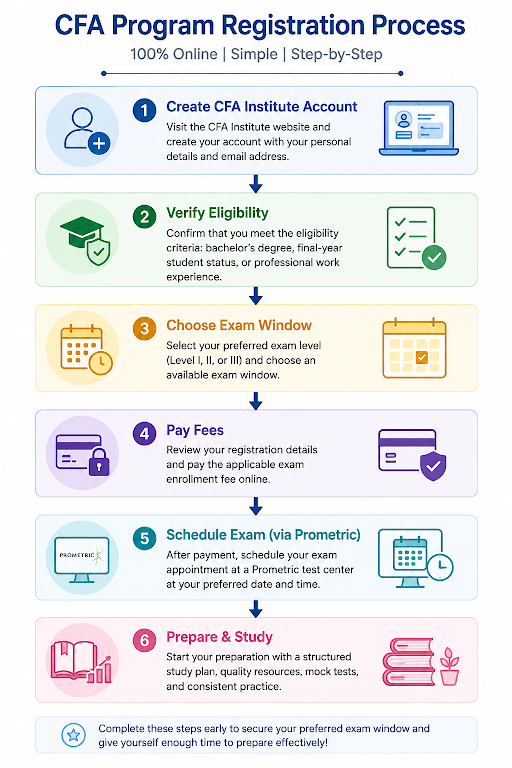
CFA Registration Process
Create CFA Institute Account
↓
Verify Eligibility (degree/final-year/work experience)
↓
Choose Exam Window
↓
Pay Fees
↓
Schedule Exam (via Prometric)
↓
Prepare & Study
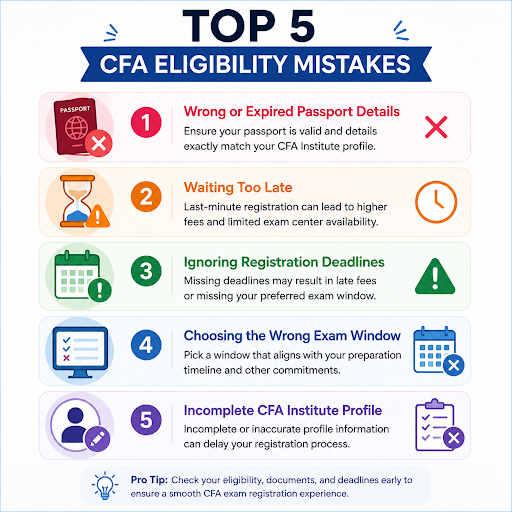
CFA Eligibility Mistakes to Avoid
- Wrong or expired passport details entered during registration — mismatches can delay or block exam-day entry.
- Waiting too late to confirm final-year eligibility, missing the 23-month registration window.
- Ignoring registration deadlines, which pushes early-bird pricing into standard or late pricing tiers.
- Choosing the wrong exam window relative to degree completion (especially risky for Level II candidates who haven’t yet graduated).
- Incomplete CFA Institute profile, leading to delays in identity verification or correspondence.
Benefits of Meeting CFA Eligibility Early
- Scholarship opportunities: CFA Institute and various access scholarships have their own deadlines, often earlier than exam registration deadlines.
- More preparation time: Early clarity on eligibility means more runway to study rather than scrambling to confirm paperwork.
- Lower stress: Sorting your passport, academic proof, and account details early removes last-minute administrative pressure closer to exam day.
- Cost savings: Early registration within each exam window typically carries lower fees than standard or late registration.
CFA Eligibility vs FRM vs ACCA vs CPA
Each of these credentials serves a different career path — CFA for investment management, FRM for risk management, ACCA for global accounting, and CPA primarily for US-based accounting and audit roles. Your choice should depend on the career direction you want, not just which one is “easier” to become eligible for.
Frequently Asked Questions
Anyone with a bachelor’s degree, undergraduates within 23 months of graduation, or candidates with 4,000 hours of relevant work/education experience over at least three years — along with a valid passport and agreement to the Professional Conduct Statement.
Yes. Students within 23 months of their expected graduation date can register for and sit Level I, but must complete their degree before advancing to Level II.
Yes. A B.Com degree fully satisfies the education requirement, regardless of specialization.
No. Work experience is not required to register for or sit Level I. It becomes relevant only when you apply for the CFA charter after clearing all three levels.
No formal exemption exists for CAs in the CFA Program. However, CA qualification typically satisfies CFA’s education/work-experience eligibility, and the overlapping subject knowledge can make preparation easier.
Yes. Any bachelor’s degree, including engineering degrees, meets the CFA education requirement.
Yes. A valid international travel passport is mandatory for registration and is the only accepted ID at the test center.
A bachelor’s degree in any discipline, final-year student status (within 23 months of graduation), or 4,000 hours of combined work/education experience over three-plus years.
Yes, but only through the work-experience route — 4,000 hours of professional work and/or higher education accumulated over a minimum of three consecutive years, without needing a completed degree.
Your registration may be rejected or your candidacy could be flagged for review, since CFA Institute can request proof of education or work experience at any time, even after registration. It’s important to confirm you genuinely meet one of the eligibility routes before registering.
Most countries are permitted, but CFA Institute cannot process registrations from individuals residing in countries subject to international sanctions (in line with US OFAC-style restrictions).
No formal English test score is required, but strong English comprehension is essential since the entire curriculum and exam are delivered in English.