

You can know every Learning Outcome Statement (LOS) in the curriculum and still have a terrible exam day. Every window, a handful of candidates are turned away at the door — not because they didn’t study, but because their passport expired, their name didn’t match their CFA Institute account, or they walked in with the wrong calculator.
The exam tests your finance knowledge. The test centre tests your paperwork.
This guide is the complete CFA exam day checklist for 2026: the two items you genuinely cannot sit the exam without, the optional items worth carrying, everything that’s banned, and a step-by-step walkthrough of what actually happens from the moment you arrive at the Prometric centre to the moment you submit your final answer. Everything here follows current CFA Institute exam-day guidelines, with specific notes for candidates appearing from India.
CFA Exam Day Checklist at a Glance
What to Bring to the CFA Exam: The Two Non-Negotiables
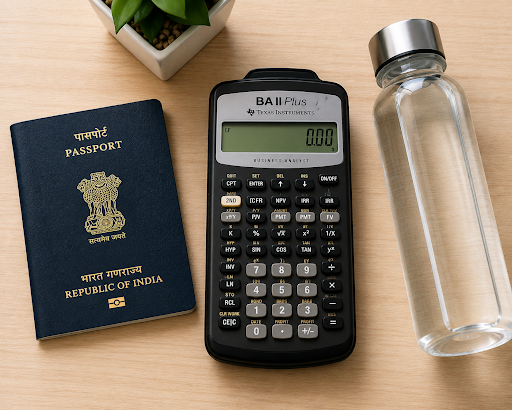
1. A Valid International Travel Passport
Your passport is the only identification CFA Institute accepts. Not Aadhaar, not a PAN card, not a driving licence, not a photocopy, not a photo on your phone. If you arrive without your original, valid passport, you will not be seated — no exceptions, no refund for that attempt.
Three checks to run today, not the night before:
- Expiry date. Your passport must be valid on exam day. If it expires before your window, start the renewal process immediately — Indian passport renewal via Passport Seva typically takes 1–3 weeks with normal processing, longer if police verification is required.
- Name match. The name on your CFA Institute account must match your passport exactly — same spelling, same order, no dropped middle names. (More on this below; it is the single most common problem for Indian candidates.)
- Physical condition. A damaged passport can be rejected. If yours has torn pages or water damage, replace it.
2. A CFA-Approved Calculator
Only two calculator families are permitted, with no exceptions:
- Texas Instruments BA II Plus — including the BA II Plus Professional. This is the model most candidates (and most prep providers) use.
- Hewlett Packard 12C — including the Platinum, 25th anniversary, 30th anniversary, and Prestige editions.
You may bring the calculator’s case, loose spare batteries, and a small screwdriver for replacing them — all are allowed at your workstation. Proctors will inspect the calculator during check-in.
Optional Items Worth Carrying
- Water in a clear, label-free bottle. Permitted at many centres; keep it transparent with no writing or images. Sip during the session if allowed, but remember restroom breaks eat into your exam clock outside the scheduled break.
- A light sweater or jacket. Prometric rooms are air-conditioned aggressively. Dress in layers — comfort is the entire dress code; there is no formal attire requirement.
- Soft foam earplugs (no cords). Keyboards click, chairs creak, and other candidates type through your concentration. Earplugs are usually permitted after inspection.
- Essential medication and medical devices. Permitted for your comfort; carry only what you need and expect inspection. Anything unusual is worth confirming with CFA Institute in advance.
- Snacks — for the locker, not the room. Food is not allowed inside the testing room, but you can eat during the optional 30-minute break. A banana, protein bar, or trail mix beats a heavy meal.
What NOT to Bring to the CFA Exam
Everything below either stays at home or goes into the locker at check-in. Bringing a prohibited item into the testing room — even accidentally — can lead to dismissal and a Professional Conduct investigation.
The Passport Name-Match Rule: Where Indian Candidates Get Caught
Real patterns we see with Capstone students every window:
Fix it early: log in to your CFA Institute account at least a month before your exam and compare the name field against your passport’s data page. If they differ, update your account or contact CFA Institute support well before exam day — name corrections cannot be handled at the test centre.
Your Pre-Exam Countdown: From One Month Out to Exam Morning
-
One Month Before
- Log in to your CFA account and confirm your appointment date, time, and test centre address.
- Verify your passport is valid through exam day, and the name matches your account exactly.
- Do a practice run of the travel route at the same time of day as your appointment — Mumbai traffic at 7 a.m. and 11 a.m. are different exams in themselves.
- Work through the official exam software tutorial and take at least one full mock on the CFA Institute Learning Ecosystem so the interface feels familiar.
The Week Before
- Reconfirm appointment details — centres and times occasionally change.
- Replace calculator batteries and learn how to clear the calculator’s memory (proctors may ask).
- Re-read the personal belongings policy once so nothing in your pockets surprises you at security.
- Taper your studying. The final week is for revision and mocks, not new material — see our guidance on structuring the last stretch in the CFA Level 1 study plans linked below.
The Night Before
Pack a single small pouch (it will go in the locker) with:
- Passport — physically check it is in the pouch; don’t assume
- Calculator + spare batteries + small screwdriver
- Clear water bottle and a locker snack
- Earplugs, medication, glasses if you use them
Then stop. No late-night cramming — sleep is the last item on the checklist, and it is not optional. A rested brain recalls formulas that a tired one blanks on.
Exam Day Morning
- Eat a light, familiar breakfast. Exam day is not the day to experiment with food.
- Moderate the caffeine — enough to be alert, not enough to need three restroom trips.
- Leave early enough to arrive at least 30 minutes before your appointment time — CFA Institute’s own guidance. Arriving late can mean being refused admission. Building in a 45–60 minute buffer for Indian metro traffic is cheap insurance.
What Happens at the Test Centre: Step by Step
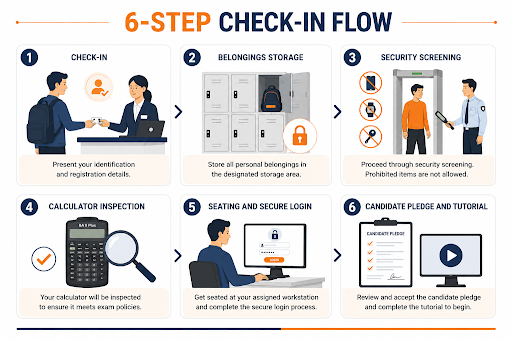
- Check-in. Present your passport; staff verifies your identity and appointment.
- Belongings storage. Everything except permitted items goes into a small locker — phones off before they go in.
- Security screening. Expect pockets turned out, sleeves and wrists checked, eyeglasses inspected, possibly a handheld metal-detector wand, and in some centres a fingerprint or palm scan. It is routine — every candidate goes through it.
- Calculator inspection. A proctor checks your calculator model; you may be asked to show cleared memory.
- Seating and secure login. You are escorted to a workstation and enter a unique keycode provided at the centre to unlock your exam.
- Candidate pledge and tutorial. You acknowledge the pledge on screen and can run a short interface tutorial before the clock starts.
The room itself: testing rooms typically seat up to about 25 candidates at partitioned workstations, under CCTV monitoring, with proctors walking the floor. If your equipment misbehaves, raise your hand — keep working if you can until a proctor reaches you.
Inside the Exam: Sessions, Timing & the 30-Minute Break
That is 180 questions across roughly 4.5 hours of testing — about 90 seconds per question. Levels 2 and 3 follow the same two-session structure with vignette-based item sets (and constructed-response questions at Level 3).
7 Common Exam-Day Mistakes (and How to Avoid Them)
- Discovering a passport problem in the final week. Check expiry and name match a month out.
- Bringing the wrong calculator. A scientific calculator, a financial model outside the approved list, or a phone app will all be rejected.
- Arriving with minutes to spare. Check-in takes time; late arrival can mean refused admission with no refund.
- Wearing complicated outfits. Every accessory is one more thing security has to inspect. Simple layers, minimal jewellery.
- Skipping the software tutorial. Fumbling with flagging and navigation costs real minutes. Practise on official mocks so the interface is muscle memory.
- Heavy lunch or caffeine overload. Both sabotage Session 2. Eat light, sip steadily.
- Deferring out of nerves. Unless something is genuinely wrong, sit as planned — deferral costs momentum, and historically deferred candidates pass at lower rates. Pre-exam anxiety is normal; it is not a reason to postpone.
After the Exam: Results and What Comes Next
If you pass, the clock starts on Level 2 — the format shifts from standalone MCQs to vignette-based item sets, and the preparation approach changes with it. If the result goes the other way, the topic bands tell you exactly where to rebuild. Either way, our CFA Level 1 study plan (6 months) and 4-month study plan show how to structure the next attempt or the next level.
CFA Exam Day: Frequently Asked Questions
Only two items are mandatory: your original, valid international travel passport and a CFA-approved calculator (TI BA II Plus/Professional or HP 12C, including Platinum editions). Optional comfort items — clear water bottle, sweater, earplugs, medication — are allowed subject to inspection.
No. CFA Institute accepts only a valid international travel passport as identification, at every test centre worldwide. No other government ID, and no photocopy, is accepted.
You may be refused entry. Compare the two at least a month before your exam and contact CFA Institute to correct any mismatch — including missing middle names, initials, or different name order. Corrections cannot be made at the test centre.
The Texas Instruments BA II Plus (including the Professional edition) and the Hewlett Packard 12C (including Platinum, 25th/30th anniversary, and Prestige editions). Spare batteries and a small screwdriver are also permitted.
Generally yes, if it is transparent with no label, writing, or images — though policies can vary by centre. Food is never allowed in the testing room; keep snacks in your locker for the break.
You cannot bring your own paper or pens. The centre provides an erasable writing tablet or laminated sheet with a dry-erase pen; raise your hand for a replacement if it fills up.
The break between sessions is optional. You may leave the room, eat, and use the restroom, but you cannot access phones, notes, or discuss the exam. Session 2 timing is unaffected by whether you take the break.
There is no dress code — comfort wins. Wear simple clothes in layers, since centres are often cold, and avoid accessories that slow down security screening.
CFA Institute recommends arriving at least 30 minutes before your scheduled appointment. Arriving late can mean being refused admission, so most candidates in Indian metros should budget a larger buffer for traffic.
About 4.5 hours of testing: two sessions of 2 hours 15 minutes each (90 questions per session, 180 total), separated by an optional 30-minute break.
Key Takeaways
- Passport + approved calculator are the only mandatory items — verify both a month out, not the night before.
- The name on your passport and your CFA account must match exactly; this is the top failure point for Indian candidates.
- Everything not explicitly permitted goes in the locker; the centre provides your writing materials.
- Arrive at least 30 minutes early, use the 30-minute break as a reset, and don’t defer out of nerves.
Exam day should be the most boring part of your CFA journey — every surprise handled weeks in advance, so the only thing left to think about is the questions on the screen. Run this checklist once a month out and once the night before, and you will walk in calm while other candidates are still arguing with security about their smartwatch.
The checklist gets you into the room; preparation gets you the pass. If you want structure for that part, explore Capstone’s online CFA classes, classroom coaching in Mumbai, or start with our free CFA resources and free CFA Level 1 webinar. Walk in ready — on paperwork and on preparation.
SEO Deliverables