

If you search for “how to prepare for CFA Level 1”, you’ll find hundreds of blogs telling you to “study 300 hours” or “stay consistent.” The problem is most of them don’t tell you what to actually do every month.
That’s where most candidates struggle.
They start preparation, but without a clear CFA Level 1 study plan, things become unstructured. Topics pile up, revision gets delayed, and mock tests are pushed to the last moment.
CFA Level 1 is not difficult because of the syllabus. It becomes difficult because of lack of direction.
In this guide, we’ll break down a structured 6-month CFA Level 1 study plan that is practical, realistic, and designed for both students and working professionals.
CFA Level 1 Preparation Strategy: What You Must Know Before You Start
Before jumping into your CFA Level 1 preparation, you need clarity on how the exam works.
CFA Level 1 is designed to test your conceptual understanding and application, not just theoretical knowledge. The exam covers multiple subjects, but the real challenge is managing the breadth of the syllabus.
Key areas include Financial Reporting & Analysis (FRA), Ethics, Quantitative Methods, Economics, Equity, and Fixed Income. Among these, FRA and Ethics typically carry higher weightage and can significantly influence your final result.
One commonly quoted benchmark is the 300-hour rule recommended by the CFA Institute. However, simply completing 300 hours does not guarantee success. What matters is how those hours are structured.
A well-planned CFA Level 1 preparation strategy focuses on:
- Concept clarity in early stages
- Regular revision throughout the journey
- Practice and mock testing closer to the exam
This balance is what separates a first-attempt pass from repeated attempts.
How Many Hours to Study for CFA Level 1 in 6 Months?
If you are following a 6-month CFA Level 1 study plan, the ideal range is around 400 to 500 hours in total.
In practical terms, this means:
- Around 2 hours per day on weekdays
- Extended study sessions on weekends
For working professionals, this approach is realistic and sustainable. For students, while more hours may be possible, consistency still matters more than intensity.
Instead of focusing only on total hours, think in terms of daily discipline. Even a well-designed study plan fails if it is not followed consistently.
CFA Level 1 6-Month Study Plan (Month-by-Month Breakdown)
They focus on how many hours to study, but ignore what to study first. In CFA Level 1, the sequence of subjects matters as much as the effort you put in.
A random approach leads to confusion, weak retention, and poor revision. A structured order, on the other hand, makes your preparation much more efficient.
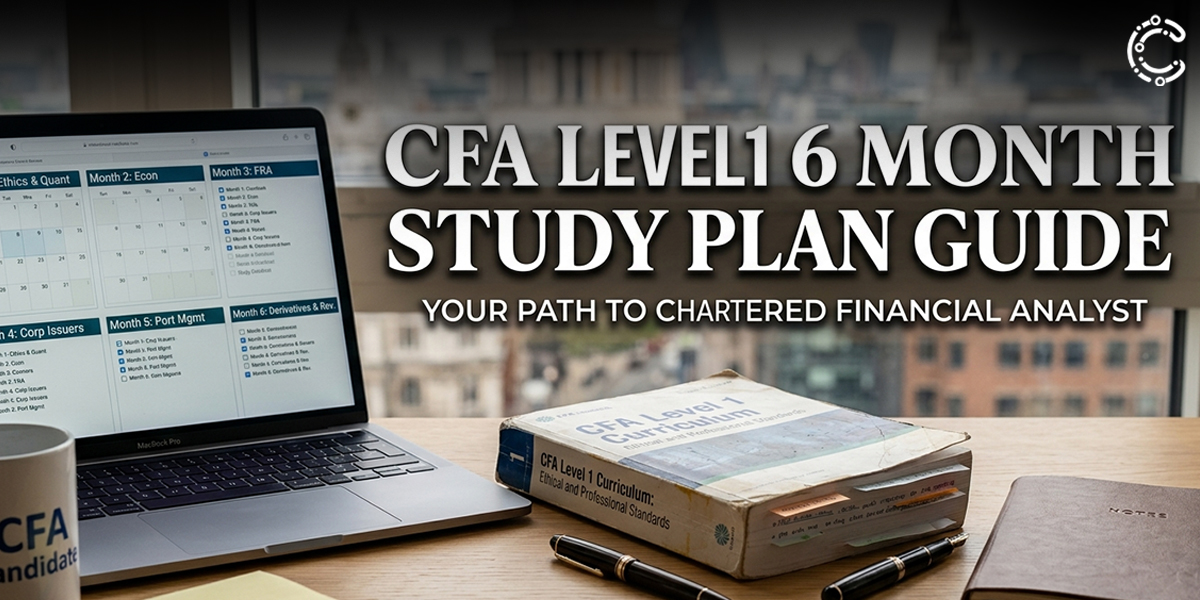
Here’s a practical 6-month plan based on how toppers actually prepare:
Month 1–2: Build Your Foundation (Start Strong)
- Quantitative Methods
- Financial Reporting & Analysis (complete, not partial)
- Corporate Issuers
Quantitative Methods helps you understand the numerical side of finance and builds the base for multiple subjects.
Right after that, move to Financial Reporting & Analysis (FRA). This is one of the highest weightage subjects in CFA Level 1, and completing it early gives you enough time for revision later.
Avoid splitting FRA across months. Completing it in one go improves clarity and retention.
Corporate Issuers can be covered alongside or after FRA. It is relatively shorter and helps you gain confidence early in your preparation.
Month 3–4: Core Finance Subjects (High ROI Phase)
- Equity Investments
- Fixed Income
These are the core finance subjects in CFA Level 1 and are heavily tested in the exam.
Your approach should now change slightly. Instead of just understanding concepts, start focusing on application.
Solve practice questions after every topic and begin revising earlier subjects weekly. This phase plays a major role in determining your overall score.
Month 5: Lighter Subjects + First Revision
- Equity InvestAfter completing the core subjects, move to:
- Economics
- Derivatives
- Alternative Investments
These subjects are relatively lighter in terms of weightage and can be covered faster once your major syllabus is done.
At the same time, start your first round of revision. Don’t wait for the last month.
Use your notes, revise formulas, and solve practice questions regularly. This is where your preparation starts becoming exam-ready.
ments
- Fixed Income
These are the core finance subjects in CFA Level 1 and are heavily tested in the exam.
Your approach should now change slightly. Instead of just understanding concepts, start focusing on application.
Solve practice questions after every topic and begin revising earlier subjects weekly. This phase plays a major role in determining your overall score.
Month 6: Final Phase (Revision + Mocks + Ethics)
Cover:
- Portfolio Management
- Ethics (keep this for the end)
Ethics is one of the most important subjects in CFA Level 1 and often becomes the deciding factor in passing. Studying it closer to the exam helps you retain concepts better.
During this phase:
- Attempt full-length mock tests
- Analyze your mistakes carefully
- Focus on weak areas
- Revise formulas and important concepts
Avoid starting anything new at this stage. Your goal is to improve accuracy, confidence, and time management.
Daily Study Schedule for CFA Level 1 (Students vs Working Professionals)
Instead, your CFA Level 1 daily study plan should match your routine.
If you are a student, you can divide your study time into multiple sessions and combine theory with practice.
If you are a working professional, a more practical approach works better:
- Short, focused study sessions on weekdays
- Longer revision and practice sessions on weekends
The key is consistency. A simple schedule that you follow every day is far more effective than a perfect schedule that you abandon after a week.
Common Mistakes in CFA Level 1 Preparation (Avoid These)
Some of the most frequent issues include:
- Starting preparation without a structured study plan
- Ignoring revision until the final month
- Not solving enough practice questions
- Relying only on reading instead of application
- Avoiding mock tests due to fear of low scores
Avoiding these mistakes alone can significantly improve your chances of clearing the exam.
How to Pass CFA Level 1 in First Attempt
Instead of looking for shortcuts, focus on:
- Understanding concepts deeply
- Practicing regularly
- Revising consistently
- Taking mock tests seriously
Most importantly, stay consistent over the entire six months. Preparation is not about a few intense days, it is about sustained effort over time.
How The Capstone Learnings Can Help in CFA Level 1 Preparation
Preparing for CFA Level 1 without proper guidance often turns into a trial-and-error process. Many students are unsure about what to study next, how much to revise, or when to start mock tests.
This lack of clarity is what slows down preparation.
At The Capstone Learnings, the entire preparation is structured in a way that removes this confusion. Instead of figuring everything out on your own, you follow a clear roadmap that covers concepts, revision, and testing in a systematic manner.
With the right guidance, preparation becomes more focused, efficient, and results-driven.
Conclusion
A well-structured CFA Level 1 study plan for 6 months can make a significant difference in your preparation.
The exam is not about studying endlessly, but about studying with clarity and consistency. When you break your preparation into phases, focus on understanding and practice, and avoid common mistakes, clearing the exam becomes much more achievable.
In the end, success in CFA is less about intelligence and more about execution.
FAQs
Yes, a structured 6-month study plan is sufficient for most candidates if followed consistently.
Around 2 hours on weekdays and more on weekends is generally recommended.
Yes, many working professionals clear the exam by following a disciplined and consistent study schedule.
A structured, phase-wise plan that includes concept building, revision, and mock testing is the most effective approach.
Start Your CFA Preparation with a Clear Plan
Stop guessing what to study next. Follow a structured roadmap, expert guidance, and a proven strategy to clear CFA Level 1.