


This comprehensive guide breaks down the core CFA Level 1 requirements, how to design a personalized CFA study schedule based on your background, allocate your CFA Level 1 preparation time by subject, and master the exam structure to pass on your very first attempt.
Mastering the CFA Level 1 Exam Structure & Timelines
The CFA Level 1 Duration and Format
- First Session (2 Hours, 12 Minutes): 88 multiple-choice questions covering tools like Ethics, Quantitative Methods, Economics, and Financial Statement Analysis (FSA).
- Optional Break (30 Minutes): A crucial window to decompress and refuel.
- Second Session (2 Hours, 12 Minutes): 88 multiple-choice questions covering asset classes and portfolio management (Corporate Issuers, Equity, Fixed Income, Derivatives, Alternative Investments, and Portfolio Management).
Plan Around the CFA Level 1 Exam Dates 2026
- February Session: February 2 – February 8, 2026
- May Session: May 12 – May 18, 2026
- August Session: August 18 – August 24, 2026
- November Session: November 11 – November 17, 2026
To avoid late fees or missing out on your preferred local Prometric testing center, keep a close eye on the official CFA registration dates. For instance, the final standard registration deadline for the November 2026 window closes on August 11, 2026.
Tailoring Study Hours to Your Background
- Commerce and Finance Graduates (250–300 Hours): If you already understand core concepts like corporate finance, accounting rules, and economics, you can progress rapidly. Your primary focus should be building concise CFA Level 1 notes and attacking practice questions.
- Engineering and STEM Graduates (300–350 Hours): While Quantitative Methods and Derivatives may feel intuitive, subjects like Financial Statement Analysis (FSA) and Ethics will require a steeper learning curve.
- Non-Finance Graduates (350–450 Hours): If you are completely new to financial terminology, concepts like double-entry bookkeeping and fixed-income mathematics will require multiple repetitions. Budget extra time early in your schedule to learn the fundamentals.
- Working Professionals: Regardless of your background, balancing a full-time job means spreading your total CFA Level 1 preparation time across a sustainable 6 to 9-month window.
Note: For the 2026 exam cycle, the CFA Level 1 curriculum has remained completely stable with zero changes to the Learning Modules or topic weights compared to the previous year. Furthermore, the one-time $350 enrollment fee has been eliminated for first-time candidates, meaning you only pay the flat exam registration fee.
Subject-Wise Hour Allocation Strategy
| Topic Area | Exam Weight | Strategic Focus & Estimated Hours |
|---|---|---|
| Ethical & Professional Standards | 15% – 20% | Critical Tie-Breaker: Highly nuanced. Dedicate 40–50 hours, focusing heavily on application in the final weeks. |
| Financial Statement Analysis (FSA) | 11% – 14% | High Priority: Historically the most challenging section. Dedicate 50–60 hours to understanding IFRS vs. US GAAP differences. |
| Equity Investments | 11% – 14% | High Priority: Core valuation concepts. Allocate 35–40 hours. |
| Fixed Income | 11% – 14% | High Priority: Complex math and yield calculations. Allocate 40–45 hours. |
| Portfolio Management | 8% – 12% | Medium-High Priority: Concepts cross-over into Equity and Fixed Income. Allocate 25–30 hours. |
| Quantitative Methods | 6% – 9% | Foundational: Master this early as it underpins the entire curriculum. Allocate 30–35 hours. |
| Corporate Issuers | 6% – 9% | Medium Priority: Capital structure and corporate governance. Allocate 20–25 hours. |
| Economics | 6% – 9% | Medium Priority: High volume of conceptual reading. Allocate 20–25 hours. |
| Alternative Investments | 7% – 10% | Medium Priority: Shorter modules, solid scoring potential. Allocate 15–20 hours. |
| Derivatives | 5% – 8% | Lower Priority: Highly technical but carries the lowest weight. Allocate 15–20 hours. |
3, 6, & 9 Month Study Plans: Choosing Your Timeline
The 3-Month Plan (The Accelerated Track)
- Weekly Commitment: 25–30 hours per week.
- Strategy: Requires a minimum of 3–4 hours of intense daily study. There is very little margin for error. You must combine reading concise summaries and completing active practice questions simultaneously from Day 1.
The 6-Month Plan (The Balanced Track)
- Weekly Commitment: 12–15 hours per week.
- Strategy: The ideal approach for the vast majority of candidates. It typically requires 1.5–2 hours on weekdays and 4–5 hours over the weekend, providing sufficient breathing room to deeply absorb complex topics like FSA without experiencing mental exhaustion.
The 9-Month Plan (The Working Professional Track)
- Weekly Commitment: 8–10 hours per week.
- Strategy: Spreads the burden evenly to prevent burnout. The main challenge here is retention; you must incorporate systematic monthly reviews using flashcards and personal summaries so that topics covered in Month 1 are not completely forgotten by Month 6.
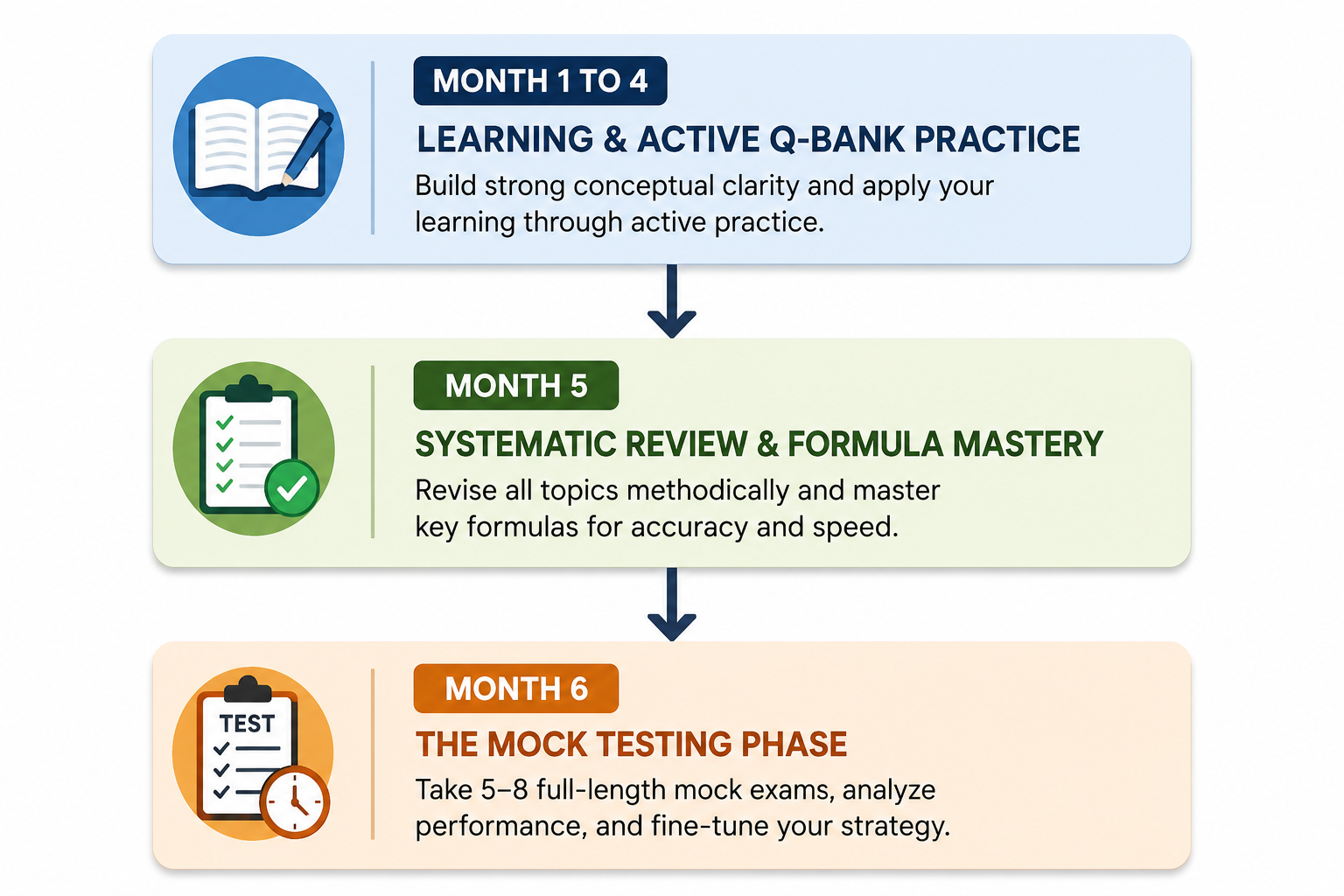
1. The Final 4–6 Weeks Countdown
Reserve the final month to 6 weeks exclusively for comprehensive review. Stop reading new material and transition entirely to active recall, formula sheet construction, and testing.
2. High-Volume Mock Exams
Aim to complete at least 5 to 8 full-length mock exams under realistic, timed testing conditions. Mocks train your brain to handle the stamina required for the full CFA Level 1 duration and teach you how to pace your 90 seconds per question.
3. The Power of the Error Log
Never take a mock exam just to check your score. The true value lies in the post-exam triage. Dedicate 2–3 hours after every single mock to analyze your mistakes. Maintain an error log tracking why you missed a question so you can revise that specific concept before opening the next mock.
Related Career Enhancements
To complement your preparation and stand out in a highly competitive job market, consider strengthening your practical toolset alongside your theoretical studies:
- To build structured learning discipline and gain access to comprehensive question banks, explore dedicated CFA Online Classes.
- To translate theoretical CFA concepts into real-world corporate value, pairing your studies with a practical Financial Modelling Course can significantly elevate your resume for valuation and investment banking roles.
Frequently Asked Questions
For many candidates with an accounting or finance background, 300 hours of highly structured study is sufficient. However, if you are a non-finance graduate or working full-time, the global average shifts closer to 348 hours. Focus on the quality of your active practice rather than just hitting a specific hourly count.
Yes, it is entirely possible to pass in 3 months if you can consistently dedicate 25–30 hours each week and already possess a baseline understanding of financial concepts. It requires a highly disciplined, compressed schedule with zero downtime.
Yes. The CFA curriculum is fully self-contained. However, utilizing structured coaching significantly improves your study discipline, streamlines complex topics, provides realistic test engines, and keeps your revision schedule on track, saving you hundreds of hours of trial-and-error.
You should aim to complete a minimum of 5 to 8 full-length, timed mock exams. Treating mock exams as a core learning tool—rather than a final checklist item—is a common trait among candidates scoring in the 90th percentile.
Financial Statement Analysis (FSA) and Ethical and Professional Standards consistently demand the most preparation time. FSA contains highly complex accounting mechanics, while Ethics requires deep practice to master the subtle contextual judgment calls tested on the exam.